
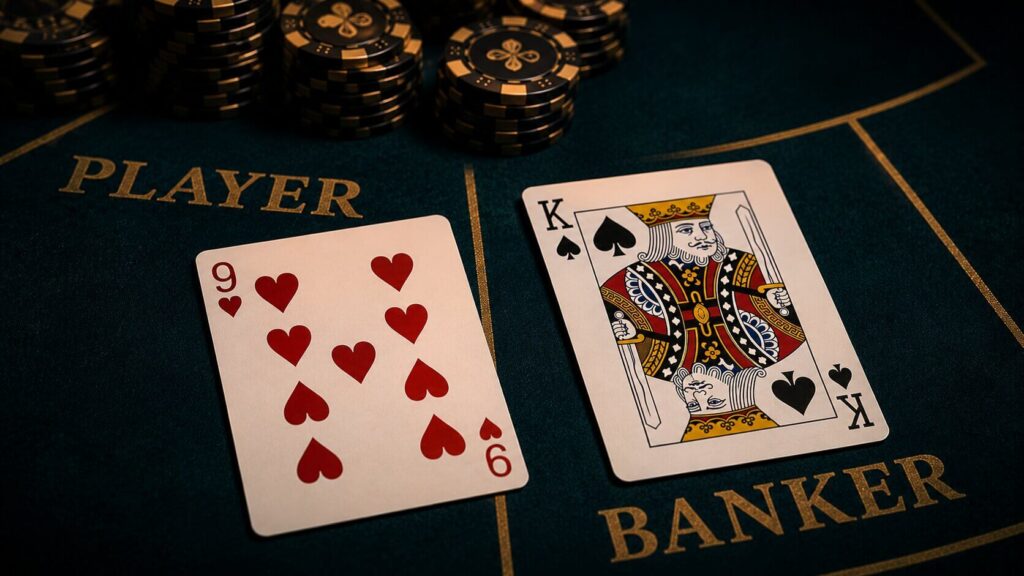
Baccarat is the simplest casino game with the lowest skill ceiling: bet Banker every hand, skip Tie, ignore the patterns on the scoreboard. The Banker bet has a 1.06% house edge, the lowest of any common casino bet. Everything else in baccarat is presentation, table selection, and discipline.
What Baccarat Actually Is
Baccarat is a card game played against the house with three possible bets: Player, Banker, or Tie. Two hands of cards are dealt, the one closer to 9 wins, and the bet you placed before the deal decides whether you win, lose, or push. There are no decisions to make once the cards are out (in the dominant version of the game), no skill to apply, no strategy to learn beyond which bet to place. It is the closest a casino card game gets to a coin flip.
What baccarat lacks in mechanical depth, it makes up for in cultural weight. The game dominates Asian casino floors in ways no Western game ever has. Macau’s casinos generate the majority of their revenue from baccarat, not slots. Genting Highlands, the dominant Malaysian land-based casino, runs more baccarat tables than any other game. Online live dealer studios offer dedicated Mandarin, Cantonese, and Bahasa Indonesian baccarat tables that exist nowhere else for any other product. If you play casino games in Malaysia, baccarat is the game you will encounter most.
The mythology around baccarat is largely Hollywood. James Bond’s actual game in Ian Fleming’s novels was Chemin de Fer, the decision-based French variant, not the decision-free Punto Banco played in Malaysian casinos today. The high-roller theatre of the cinematic baccarat scene reflects how the game was once positioned in Western casinos (cordoned off in private rooms with high minimums), not what playing the game actually involves.
How a Hand Plays Out
The game uses six or eight standard 52-card decks shuffled together (most live tables use eight). Card values are simple: aces count as 1, cards 2 through 9 count their face value, and tens and face cards count as zero. The hand value is the sum of the card values modulo 10, so a 7 and an 8 totals 15 but the hand value is 5.
The sequence of a round:
- Betting window opens. Players place chips on Player, Banker, Tie, or any available side bets.
- Dealer announces “no more bets.” Wagers are locked in.
- Two cards each are dealt to Player and Banker positions. These are not seats at the table, just bet labels. The cards represent the two hands competing for closest to 9.
- Naturals are checked. If either side has 8 or 9 on the first two cards, that is a “natural” and the hand ends immediately.
- Third-card rules are applied automatically. If no natural, fixed rules determine whether each side draws a third card. The player at the table has no input.
- The hand closer to 9 wins. Banker wins are paid 1:1 minus a 5% commission, Player wins pay 1:1, and Tie wins pay 8:1.
The third-card rules are the most complex piece of baccarat. They are mechanical, fixed, and apply automatically with no decision points for the player in Punto Banco. The Player hand draws a third card on totals 0 through 5 and stands on 6 or 7. The Banker hand’s third-card decision depends on what (if anything) the Player drew, with a small lookup table that determines drawing on totals 3 through 6. Our rules guide has the full table, but the practical reality is you never need to memorise it (the dealer or interface handles it for you).
“Player” and “Banker” are bet labels, not actual people
Despite the names, you are not playing against another player and you are not literally betting on the bank. The two hands are just labels for the two possible outcomes the table will resolve. You can bet on either, or on a tie between them, regardless of which physical seat you sit at. New players sometimes assume the Banker bet means betting “with the house” or that the dealer plays a different role on that bet. They do not.
The Three Bets and the Math
The math of baccarat is settled, well-documented, and remarkably elegant. Three primary bets, each with a known win probability and a known payout, produce three different house edges:
The underlying probabilities are also fixed (for the standard 8-deck game): Banker wins approximately 45.84% of hands, Player wins approximately 44.62%, and Tie occurs approximately 9.54%. Banker’s edge over Player is small, about 1.22 percentage points, but it is structural and permanent. It does not depend on the cards dealt, the dealer, the table, the casino, the country, the time of day, or anything that happened in the previous shoe. The bank wins more often than the player. This is the only fact about baccarat strategy you need to know.
Standard payouts:
| Bet | Payout | Win Probability | House Edge |
|---|---|---|---|
| Banker | 1:1 minus 5% commission | 45.84% | 1.06% |
| Player | 1:1 | 44.62% | 1.24% |
| Tie (standard) | 8:1 | 9.54% | 14.36% |
| Tie (rare 9:1 variant) | 9:1 | 9.54% | 4.85% |
Our bet types and payouts guide covers every bet in depth, including the calculations behind each edge and the variant rules that shift them.
Why Banker Is the Best Bet on the Floor
The Banker bet’s 1.06% house edge is not just the best bet in baccarat, it is one of the best bets in any common casino game. For comparison: blackjack with perfect basic strategy runs about 0.5%, but very few players actually execute basic strategy correctly. European roulette is 2.70% on every bet, French is 1.35% on even-money bets with la partage, and American roulette is 5.26%. Most slot games run between 3% and 10%. Banker at 1.06% beats every roulette wheel, every slot, and most informally played blackjack.
The structural reason Banker wins slightly more often is the third-card drawing rules. The Banker hand always draws or stands second, meaning the rules can react to what the Player hand drew. That asymmetric advantage shows up in approximately 1.22 percentage points of additional wins per hand. The 5% commission on Banker wins exists precisely to neutralise most (but not all) of that advantage and keep the house edge similar to the Player bet. Without the commission, the Banker bet would actually favour the player slightly.
The practical takeaway: bet Banker every hand. Not because of a streak you spotted, not because you are “feeling it,” not because the scoreboard says so. Bet Banker every hand because the math says Banker every hand, forever, with no exceptions. The 5% commission feels annoying when you watch your win get marked down on the dealer’s count, but it is the price of playing the best bet on the floor. Our strategy guide covers why this advice is genuinely the entire game.
Why Tie Is a Trap
The Tie bet pays 8:1, which sounds attractive until you do the math. The actual probability of a tie is approximately 9.54%, or roughly 1 in 10.5 hands. True odds would pay about 9.5:1. The 8:1 payout is 1.5 units short of fair, and that gap is the casino’s edge: 14.36%.
To put 14.36% in context, that is roughly fourteen times the house edge on the Banker bet. For every RM1,000 you wager on Banker over a long session, you can expect to lose about RM10.60 to the house. For every RM1,000 you wager on Tie, you can expect to lose about RM143.60. The Tie bet costs you fourteen times as much for the same time at the table.
The 8:1 vs 9:1 distinction matters
A handful of casinos (mostly in Asia, occasionally online) offer a Tie bet that pays 9:1 instead of 8:1. The house edge drops from 14.36% to about 4.85%, which is dramatically better but still worse than the Banker bet. The 9:1 Tie is the rare case where playing Tie is not actively self-destructive, but it still loses more in expectation than Banker. The standard 8:1 Tie is one of the worst common bets in any casino. Avoid it.
Side Bets
Baccarat offers a sprawling family of side bets that vary by operator: Player Pair and Banker Pair (the first two cards on that side forming a pair), Either Pair, Big and Small (based on total cards dealt), Lucky 6 / Super 6 (Banker wins with a six-point total), Dragon Bonus (winning by a large margin), Dragon 7 and Panda 8 (specific three-card totals), and dozens of others. Casinos and providers introduce new ones regularly because side bets are a significant revenue line.
The pattern across baccarat side bets is consistent: house edges between 5% and 30%. Pair bets at 11:1 carry a house edge of approximately 10.36%. Dragon Bonus on the Banker side carries about 9.37%. Super 6 at 12:1 carries a brutal 29.98%. A few side bets are less terrible (Lucky 6 at 15:1 is around 13.82%, Dragon Bonus on the Player side is about 2.65%), but none of them approach the Banker bet’s 1.06%. They are entertainment surcharges, not strategy.
The honest framing: if a side bet’s presentation excites you and you can afford to lose at higher rates for the sake of variance, place small ones. If your goal is to play the lowest-edge game baccarat offers, skip them. Our side bets guide covers every common variant with its exact house edge and the conditions under which the math shifts.
Pattern Tracking and Scoreboards
Walk past any Asian baccarat table, online or offline, and you will see scoreboards. Players carefully track the outcome of every hand on printed grids with names like the bead road, the big road, the big eye boy, the small road, and the cockroach road. Most Malaysian online live tables display them prominently in the interface. Players study them for “dragons” (long streaks), “ping pong” patterns (alternating Banker and Player), and “trends” they believe will continue or reverse.
The honest answer about pattern tracking: the scoreboards are real, beautifully designed, fascinating to look at, and absolutely do not predict future outcomes. Each hand of baccarat is statistically independent of every previous hand (give or take microscopic shifts in shoe composition that even perfect card counting cannot exploit meaningfully). A long Banker streak does not mean Banker is “hot” and likely to continue. A long Banker streak also does not mean Player is “due” and likely to break it. The shoe has no memory. The next hand’s probability of Banker winning is approximately 45.84% regardless of what happened in the previous 1, 10, or 100 hands.
The scoreboards persist because they feel meaningful, because they have been part of Asian baccarat culture for generations, and because casinos actively encourage them (a player tracking patterns plays more hands and bets larger when they think they have spotted a trend, both of which favour the house). They are accurate records of what happened. They are not predictors of what will happen. Our patterns and scoreboards guide explains exactly what each road represents and why the math says none of them help.
Variants Worth Knowing
Most baccarat variants are presentation differences (speed, theatrics, side bets, hosting style) rather than structural changes to the game. A few involve real rule changes that affect the house edge.
Punto Banco is the dominant form globally and the default game in Malaysian-facing casinos. No player decisions, automatic third-card drawing, standard 5% Banker commission, standard payouts. Everything we have covered above applies to Punto Banco. Our Punto Banco guide goes deeper.
Chemin de Fer is the original French variant where the player on the Banker hand can choose whether to draw a third card on certain totals. James Bond’s actual game in Ian Fleming’s novels. Almost extinct in modern online play but historically significant. Our Chemin de Fer guide covers the differences and why the variant matters.
Mini Baccarat is Punto Banco at lower stakes and faster pace, played on a smaller table. Same math, smaller minimum bets. Most online “baccarat” without a specific variant name is structurally Mini Baccarat.
Speed Baccarat compresses each round to roughly 27 seconds, double the hand rate of standard tables. Same math, more action per hour.
Squeeze Baccarat slows the card reveal dramatically, with the dealer or player slowly bending the cards to build suspense. Same math, much slower hand rate, common in high-roller settings.
No Commission Baccarat (sometimes called Super 6, Punto Banco 2000, or Commission Free Baccarat) pays Banker wins at 1:1 with no commission, EXCEPT when Banker wins with a total of 6, in which case the payout drops to 1:2. Sounds player-friendly. Is not: the Banker house edge rises from 1.06% to 1.46%.
EZ Baccarat pays Banker wins at 1:1 with no commission, but pushes when Banker wins with a three-card total of 7. Banker house edge: 1.02%, marginally better than standard. Includes optional side bets (Dragon 7 at 40:1, Panda 8 at 25:1) with much higher edges.
Lightning Baccarat is Evolution‘s branded variant with random multipliers on selected cards, paying enhanced wins when those cards appear in the winning hand. Higher variance than standard, and the base bet edge is elevated to fund the multipliers. Mirrors the structure of Lightning Roulette. Our Lightning Baccarat guide covers the math.
Dragon Tiger is a simplified one-card-per-side game often offered alongside baccarat. Closer to a pure coin-flip than baccarat proper, with similar Tie-bet traps. Listed in our variants guide for completeness, though it is technically a different game.
Live Baccarat and the Malaysian Context
Online baccarat splits into RNG (digital) tables and live dealer tables. RNG tables are faster, accept smaller minimum bets, run reliably on mobile, and use audited random number generators that produce mathematically equivalent outcomes to physical card play. Live dealer tables stream real cards from real dealers in professional studios, with table minimums typically higher and the experience closer to a physical casino.
For Malaysian players, live dealer baccarat is the dominant product. Most operators we cover offer dozens of live baccarat tables across multiple providers. Evolution runs the most expansive catalogue including Speed Baccarat, No Commission Baccarat, Lightning Baccarat, and Squeeze. Pragmatic Play‘s live arm has invested heavily in Asian-language tables. AE Sexy, SA Gaming, Dream Gaming, and PlayAce (formerly Asia Gaming) all run substantial baccarat-focused catalogues tailored to Asian markets. Mandarin and Cantonese dealer tables are widely available and often staffed at peak Malaysian hours.
The math is identical across providers. What varies is presentation: studio quality, dealer professionalism, interface clarity, scoreboard display style, table minimum, and language coverage. Our live baccarat guide covers each major provider in detail, including the trade-offs between studio formats.
“Strategy”: What Actually Helps
The entire baccarat strategy, in three sentences
Bet Banker every hand. Skip the Tie bet and skip the side bets. Manage your bankroll and walk away when you hit your limits. There is no fourth sentence.
Baccarat is unusual among casino games in that “strategy” is almost entirely about what bets to avoid rather than what to bet. The Banker bet at 1.06% house edge is mathematically the only sensible choice. The Player bet at 1.24% is acceptable. Everything else (Tie, side bets, betting systems, pattern-based bet sizing) loses money at higher rates.
Three things that genuinely help, despite not being “strategy” in the traditional sense:
Pick the right table. Standard commission-based Punto Banco (1.06% Banker edge) beats No Commission Baccarat (1.46% Banker edge). EZ Baccarat (1.02% Banker edge) is marginally better than standard. The “no commission” framing on Super 6 tables sounds player-friendly but is actually worse for you; the math is in the variant rules, not the marketing.
Skip the systems. No betting progression beats the house edge in baccarat. We explain why in the section below, and our betting systems guide walks through each major system with the specific math of why it fails.
Manage your bankroll like the cards have no memory. Because they do not. Bet a small fixed fraction of your session bankroll per hand, set a stop-loss and stop-win before you sit down, and walk away when you hit either. Variance in baccarat is real and short sessions can swing dramatically in either direction; the math only converges to the expected loss over many thousands of hands.
Betting Systems Do Not Work
Every progressive betting system ever invented has been tried on baccarat: Martingale (double after losses), Paroli (double after wins), Fibonacci (follow the Fibonacci sequence), 1-3-2-4 (a specific four-bet progression), Labouchere (cross out numbers from a sequence), the D’Alembert system, and dozens of regional variants. None of them work.
The reason is mathematical. The shoe has no memory. Each hand’s outcome is approximately independent of every previous hand. Multiplying your bet by any factor, or adjusting it according to past results, does not change the probability of the next outcome. The negative expected value of each bet remains negative; rearranging the bet sizes over time does not flip the sign of the sum.
The reason systems persist is psychological. Martingale and its variants produce lots of small wins punctuated by occasional catastrophic losses. The shape of the equity curve feels like winning right up until it does not. Casinos welcome system players because the systems require larger total wagering than flat betting, and the casino’s edge applies to total wagering. Players using Martingale lose money faster, not slower. Our betting systems guide covers each major system, the specific math of why it fails, and the bankroll-size threshold at which each system busts.
Advantage Play: Edge Sorting, Not Counting
Unlike blackjack, baccarat is essentially impossible to beat with card counting. Edward Thorp, James Grosjean, and Peter Griffin all studied the question independently and reached the same conclusion: counting cards in baccarat gains an ideal counter approximately 0.01% per hand in expected value. One basis point. The Banker bet’s structural edge cannot be flipped by tracking deck composition because the game’s symmetry means there are no cards that meaningfully favour one side over the other across enough situations to matter.
The one advantage play technique that has genuinely beaten baccarat is edge sorting, made famous by Phil Ivey and his collaborator Cheung Yin Sun (often called “Kelly Sun”). The technique exploits subtle, asymmetric patterns on the backs of certain card decks (manufacturing imperfections that mean the long-edge pattern on one side of a card is slightly different from the other). A player who can identify these patterns can request that the casino rotate high-value cards (typically 8s and 9s) one way and low-value cards the other, gaining advance information about what is about to be dealt.
Ivey and Sun’s case made global news. They won approximately £7.7 million at Crockfords Club in London in 2012 and approximately $9.6 million at the Borgata in Atlantic City the same year. Both casinos refused to pay and sued. UK courts ruled against Ivey through three levels of appeal, concluding at the Supreme Court in 2017, classifying edge sorting as a form of cheating rather than legitimate advantage play. US courts reached the same conclusion in the Borgata case. The legal precedent now treats edge sorting as illegal in most jurisdictions, and casinos have changed their card-handling procedures specifically to defeat it.
For practical purposes today, baccarat has no available player edge. Treat the Banker bet’s 1.06% house edge as the floor and play accordingly. Our advantage play guide covers the Ivey and Sun cases in detail and explains why card counting is mathematically interesting but practically useless.
Bankroll Discipline
Bankroll management is the only thing in baccarat you actually control. The math of the house edge is fixed; how much you risk per hand, how long you play, and when you walk away are not.
Practical guidelines for recreational players:
- Bet 1% to 2% of your session bankroll per hand. If you brought RM500, bet RM5 to RM10 per hand. The temptation to “make it back” by jumping to RM50 is how RM500 sessions become RM2,000 sessions.
- Set a stop-loss and a stop-win before you start. The stop-win is harder to follow and more valuable. Wins you leave on the table are wins that get given back.
- Treat each session as independent. The shoe does not know you are up or down. “Due for a win” is the most expensive sentence in gambling.
- Track your play honestly. Not for tax reasons, for accuracy. People remember big wins and forget the grind down; a notebook fixes the bias.
Winning Habits vs Losing Habits
- Bets Banker every hand, no exceptions
- Skips Tie bets and most side bets
- Bets a fixed percentage of bankroll
- Walks away at stop-loss or stop-win
- Ignores scoreboard patterns
- Switches between Banker and Player on “feel”
- Chases the 8:1 Tie payout
- Doubles bets to recover losses
- Bets large on perceived hot streaks
- Treats the big road as a prediction tool
Frequently Asked Questions
Is baccarat really better than blackjack for the player?
On house-edge terms, baccarat (1.06% Banker bet) is slightly worse than blackjack with perfect basic strategy (around 0.5%), but better than most blackjack as actually played by recreational players who do not follow the chart precisely. Baccarat’s advantage is that you cannot make a “wrong” decision because you are not making any decisions; the math is the math regardless. Blackjack’s basic strategy advantage only applies if you actually execute the chart, which most players do not.
Do the scoreboards (big road, bead road) actually predict anything?
No. Each hand of baccarat is statistically independent of the previous hand. Long streaks do not predict continuation or reversal. The scoreboards are accurate records of what happened, but baccarat outcomes have no autocorrelation that the scoreboards could detect. The pattern-tracking culture in Asian baccarat is genuine and longstanding, but the math does not support it. Our patterns guide explains exactly what each road represents and why none of them help.
Should I ever bet on Player instead of Banker?
Mathematically, no. The Banker bet’s 1.06% house edge beats the Player bet’s 1.24% by a small but permanent margin. The only reason some players bet Player is the absence of the 5% commission on wins, which means Player wins feel cleaner. Over thousands of hands the math wins. If you are playing a short session and prefer the no-commission experience, Player is acceptable. For optimal play, Banker every time.
Is the Tie bet ever worth taking?
Effectively no. The standard 8:1 Tie carries a 14.36% house edge, one of the worst common bets in any casino. The rare 9:1 Tie (offered occasionally in Asia and online) carries 4.85%, which is dramatically better but still worse than the Banker bet. There is no version of the Tie bet that beats Banker. If you enjoy the high-variance gameplay of occasionally hitting an 8:1 payout, small Tie bets are entertainment. Treat them as such, not as strategy.
Can I count cards in baccarat?
Theoretically yes, practically no. Edward Thorp and Peter Griffin both studied counting in baccarat and concluded that an ideal counter playing perfectly gains approximately 0.01% per hand in expected value. That is one hundredth of one percent, an amount so small that natural variance swamps it across any realistic number of hands. Card counting in baccarat is mathematically interesting but commercially useless. Edge sorting (the Phil Ivey technique) is a different matter, but it is now classified as cheating in most jurisdictions and casinos have countermeasures specifically to defeat it.
Why is baccarat so popular in Asia?
A combination of cultural and structural factors. The game’s simplicity (no decisions required) suits high-volume high-stakes play. The fixed math means perceived “luck” rather than skill determines the outcome, which aligns with Chinese gambling traditions that value fortune over technique. Macau’s casino industry concentrated almost exclusively on baccarat from the 2000s onward, making it the dominant Asian casino product and reinforcing its cultural status. Today baccarat generates the majority of casino revenue in Macau, and the game’s prominence in Asian-facing online operators (including most Malaysian-licensed offshore casinos) reflects that dominance.
The Cluster, at a Glance
Everything else on baccarat, organised:
- Start here if new: Rules, then Bet Types and Payouts, then Strategy.
- The bets beyond the basics: Side Bets (Dragon Bonus, Pairs, Lucky 6, Super 6).
- The Asian cultural layer: Patterns and Scoreboards (big road, bead road, big eye boy).
- The variants you will meet: Punto Banco, Chemin de Fer, Lightning Baccarat, and the rest (Mini, Speed, Squeeze, No Commission, EZ).
- How online play actually works: Live Baccarat.
- What does not work: Betting Systems.
- What did work (briefly, illegally): Advantage Play and Edge Sorting.
- Reference: Glossary.
Bet Banker, skip Tie, ignore the patterns, manage your bankroll. That is the entire game. When you are ready to play for ringgit, our best online baccarat casinos for Malaysia page lists the operators we rate most highly, evaluated on live baccarat depth, provider variety (Evolution, Pragmatic Play, AE Sexy, SA Gaming, Dream Gaming, PlayAce), and MYR banking speed. The cluster guides above cover every other angle worth knowing.